
Over the past year, we've had the opportunity to work on implementing data governance solutions in a large enterprise while navigating the complex challenges that come with managing data at scale. This experience has shaped how we think about data governance: we've seen firsthand the pain points that plague organizations without proper data management, and we've also been able to build and deploy solutions that address these challenges systematically. Today, we want to share with you the practical approach we took to build a comprehensive data governance platform from the ground up, and the lessons we learned along the way.
Introduction: Understanding Data Governance
Picture this: you're a data analyst at a large organization. Monday morning greets you with an urgent request from the marketing team: they need customer segmentation data for a campaign launching next week. You know the data exists somewhere, but you're not sure which dataset to use. You ask around in a company chat, hoping someone knows. Days pass. You finally find a dataset, but you're not sure if you have permission to access it. You fill out a form—or is it a different form? You wait. No response. You discover the data owner left the company months ago, and your request is stuck in limbo. Meanwhile, you accidentally stumble upon a dataset containing sensitive customer banking information that you definitely shouldn't have access to. Suddenly, data governance isn't just an abstract concept; it's a daily operational nightmare affecting productivity, security, and compliance.
This is where data governance, done right, becomes a strategic asset. At its core, data governance is a comprehensive framework that encompasses the policies, procedures, and standards needed to manage an organization's data assets effectively. It involves the oversight of data management to ensure data accuracy, security, usability, and compliance with regulations. The primary goal is to ensure that data is reliable, consistent, and used responsibly throughout its lifecycle.
Without proper governance, organizations face a cascade of problems: data silos, security breaches, compliance violations, and decision-making paralysis. But with a well-designed governance framework, data becomes a competitive advantage: enabling faster insights, ensuring regulatory compliance, and building trust with stakeholders.
Why Data Governance Matters
Why should companies invest in robust data governance? The answer lies in the fundamental role data plays in modern business operations. Let's explore the key benefits:
1. Enhances Data Quality
High-quality data is accurate, complete, reliable, and relevant—essential for making sound business decisions. Strong data governance practices ensure that data is consistently monitored, cleaned, and validated. This systematic approach minimizes errors and builds trust in data-driven decisions, enabling organizations to act confidently on insights derived from their data.
2. Improves Data Security
With increasing instances of cyberattacks and data breaches, securing sensitive information has become critical. A robust data governance system implements stringent security protocols, including encryption, access controls, and regular security audits. This helps prevent unauthorized access and potential breaches, protecting both the organization and its stakeholders.
3. Ensures Regulatory Compliance
A company's governance mechanisms ensure compliance with legal requirements for handling personal information, avoiding substantial fines from regulators and potential legal consequences. In an era of increasing data privacy regulations, compliance isn't optional—it's a business imperative.
4. Facilitates Better Decision-Making
The foundation of effective business analytics and intelligence lies in accurate and properly managed data. When companies maintain high-quality, accessible databases, they can make better and more timely decisions, driving profitability and competitive advantage. Data governance ensures that decision-makers have access to reliable, relevant information when they need it.
5. Increases Operational Efficiency
Poor data management leads to duplication, wasting resources allocated to storage systems. Well-structured data governance reduces unnecessary duplication, enabling faster access to reliable information. This enhances productivity and lowers costs associated with storing redundant records, while also reducing the time analysts spend searching for the right data.
6. Promotes Data Transparency and Accountability
Clear governance frameworks establish transparency about data ownership, usage, and responsibilities. This facilitates responsible use of the organization's data assets by employees. Well-defined roles ensure that individuals understand their responsibilities for specific datasets, creating accountability throughout the data lifecycle.
7. Mitigates Risks
Data management faces numerous risks: breaches, non-compliance, and poor-quality data. By proactively addressing these challenges before they manifest, businesses can avoid losses resulting from data mismanagement and protect their reputation. Governance acts as a risk management framework for data assets.
8. Ensures Data Privacy
Customers increasingly view companies with strong data governance practices as trustworthy stewards of personal information. This builds customer trust, a critical element for business continuity and brand reputation in an era where data privacy concerns are at the forefront of consumer consciousness.
Recognizing the Symptoms: When Data Governance Is Failing
Before we dive into solutions, it's crucial to recognize when an organization is suffering from poor data governance. These symptoms often manifest in daily operations:
Lack of Policy Awareness: Employees don't know the company's data governance policies, nor do they understand their purpose or how to apply them in their work.
Slow and Confusing Access Processes: Data access requests take too long to process. Employees don't know which form to fill out—or discover there are multiple forms for the same purpose. There's no way to track request status, leaving people in the dark about whether their access will ever be granted.
Weak Access Controls: Security measures are insufficient or easily bypassed. There are no usage controls or audit trails. Employees can access sensitive data without proper authorization, creating significant security and compliance risks.
Unclear Ownership and Responsibility: Nobody knows who to ask for data access. The organizational structure around data ownership is opaque. Requests get stuck because the designated data owner left the company months ago, and there's no process to reassign ownership. The relationship between roles, teams, and datasets is unclear.
Poor Data Discovery: Analysts can't find the datasets they need for their analysis. The typical workflow involves asking in a company chat and hoping someone knows the answer—a tedious and inefficient process that doesn't scale.
Data Duplication and Inconsistency: Multiple versions of the same dataset exist, with no clear source of truth. Maintaining data integrity becomes nearly impossible when you can't determine which dataset is authoritative.
Poor Metadata Quality: Datasets have tables and columns with unclear, non-descriptive names, or no descriptions at all. This makes it difficult for users to understand what data they're working with.
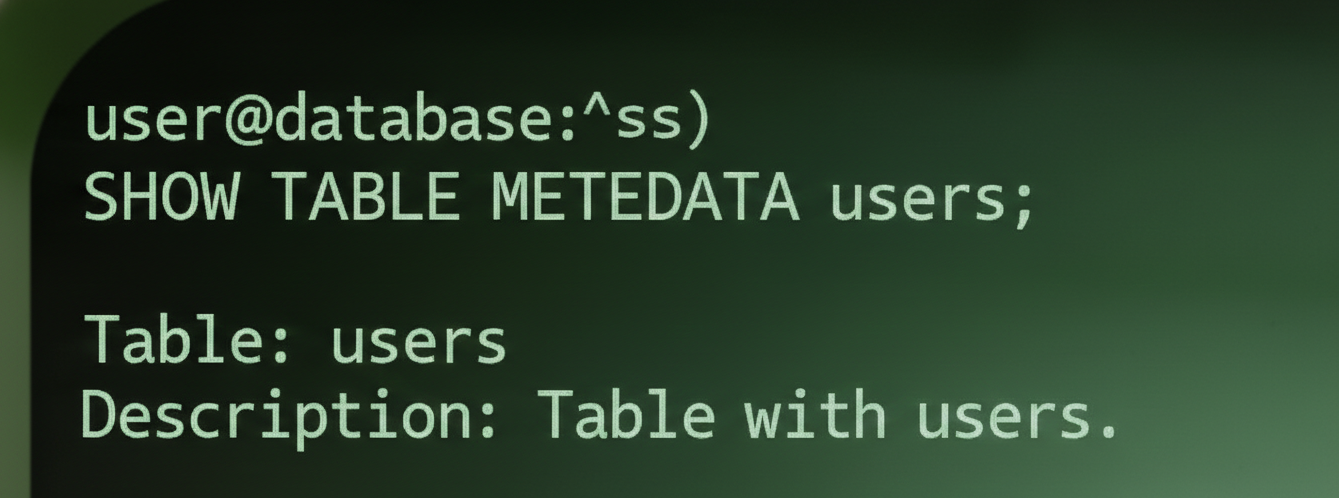
Unauthorized Access to Sensitive Data: Employees can view sensitive information like customer address details or personally identifiable information without proper authorization, creating serious compliance and security risks.
Missing Context: When viewing a dataset, there's no way to know what type of data it contains, who's responsible for it, whether it's processed or raw data, or where it originated. This lack of context makes data usage risky and inefficient.
The Risks of Poor Data Governance
When these symptoms persist, organizations face significant risks:
Data Breaches: Weak access controls and poor security practices lead to unauthorized access and potential data leaks, resulting in financial losses, regulatory penalties, and reputational damage.
Inefficient Data Usage: Without proper governance, teams waste time searching for data, duplicating efforts, and making decisions based on incomplete or incorrect information.
Insufficient Data for Decision-Making: Poor data quality and discoverability mean that decision-makers lack the information they need, leading to suboptimal business outcomes.
Legal and Regulatory Problems: Non-compliance with data protection regulations can result in massive fines, legal action, and restrictions on business operations.
Data Silos: Information isn't shared effectively between departments, leading to fragmented understanding and missed opportunities for collaboration.
Data Inconsistencies: Without a single source of truth, different teams work with conflicting data, leading to confusion and errors in reporting and analysis.
Building a Solution: Our Journey
As a team, we faced these exact problems and set out to solve them systematically. In this section, I'll explain how we approached the solution, working through problems in order of priority and organically evolving to what we have today.
The Federated Approach
Early on, we recognized that implementing data governance in a large enterprise required a federated approach. Rather than centralizing all governance decisions, we designed a system where each team would be responsible for governing the data in their domain. This transformed our data governance team into an enabler, providing the tools and processes necessary for teams to manage their own data effectively.
However, we also understood that one of the biggest problems was the lack of knowledge about policies, processes, and roles. To address this, we decided to centralize this information and all governance processes within a single platform. This platform would serve as the single source of truth for governance information while enabling federated ownership and decision-making.
The Microservices Architecture
Given the scope of the challenges identified, we recognized that each domain—cataloging, lineage, and quality—is significant enough to be its own ecosystem. Attempting to house these distinct complexities within a single codebase would quickly become overwhelming and technically stagnant.
To solve this, we adopted a microservices architecture. By segmenting the platform, we ensure that the sheer scale of data governance remains manageable. This approach allows us to utilize the most appropriate tools and tech stacks for each specific use case, rather than forcing a "one size fits all" solution across the entire platform. While all services connect through a unified frontend to provide a seamless user experience, the underlying separation of concerns remains the backbone of our flexibility.
Key Advantages of this Segmentation:
- Reduced Cognitive Load: Teams manage specialized codebases, preventing the platform from becoming a "monolithic" burden.
- Technology Agnostic: We can use the best language or database for a specific governance task without impacting other services.
- Independent Life Cycles: Develop, test, and deploy features for one module without the risk of blocking or breaking another.
- Elastic Scalability: Scale only the components that face high demand, such as metadata ingestion, without over-allocating resources elsewhere.
- Incremental Integration: Facilitates a "plug-and-play" approach with existing legacy systems.
5.1. Access Management: The Foundation
One of the highest-priority pain points was data access. Users didn't know who to ask for access, which form to use, or how to track their requests. This was the first service we developed.
The Access Service handles the complete lifecycle of data access management, including request submission and tracking. From the user's perspective, this appears as a module offering a unified form to request access to data. Users can view the status of their requests—both those they've created and those where they need to approve or reject access. Finally, users can explore available data and understand what they can request access to.
This service transformed a chaotic, multi-form, untrackable process into a streamlined workflow. What used to take weeks (or never get resolved) now has clear visibility and accountability.
5.2. Discovery: Finding the Right Data
Another urgent problem was helping users discover which data assets they need to answer business questions. The typical workflow involved asking in a company chat and hoping someone could point to the right dataset—a tedious and inefficient process that didn't scale.
We developed a Discovery Service to address this. This service shows users relevant data to their needs, powered by semantic search and natural language processing. Users can ask natural language questions, and the service presents the best match for their requirements, along with relevant metadata.
This capability dramatically reduces the time analysts spend searching for data, enabling faster insights and better decision-making.
5.3. Organizational Context: Structure and Knowledge
The Organizational Knowledge microservice was designed to eliminate the ambiguity surrounding data ownership and corporate standards. Previously, users struggled to navigate a fragmented landscape where roles were undefined and policies were hidden. This single service now manages the entire organizational model, merging human hierarchy with a centralized knowledge base to define how data is governed and who is responsible for it.
By grouping data into logical business domains and subdomains, the microservice maps specific datasets to their respective owners and stewards. This creates a transparent chain of command, ensuring that accountability is clear and that users know exactly who to contact for access or quality concerns. It transforms the directory from a simple list of names into a functional map of data responsibility.
This same service also powers the centralized Resources module, acting as the official repository for the company's data policies and best practices. By housing documentation and process guides within the same service that defines roles, we ensure that governance knowledge is directly linked to the people who implement it. This integration makes the "Data Language" of the company discoverable and actionable.
Ultimately, this unified microservice addresses the common problem of policy unawareness by providing a single source of truth for both structure and knowledge. It ensures that every user, regardless of their department, operates under the same rules and understands the organizational context of the data they use.
5.4. Catalog: Metadata Management
- The Catalog Service acts as the central repository for all data assets, maintaining a rigorous record of their metadata to ensure every table is fully contextualized. Within this single service, we track the specific data layer—categorizing assets as BRONZE, SILVER, or GOLD based on their processing stage—while simultaneously identifying the source system of origin. It also maps each asset to its responsible squad, ensuring that the team owning and maintaining the data is always identifiable, which transforms the catalog from a simple list into a manageable map of the company's data landscape.
Additionally, this service handles integration with the company's data catalog, enabling retrieval and updates of data asset metadata. This integration ensures that governance metadata stays synchronized with the actual data assets, maintaining accuracy and relevance.
The catalog service acts as the metadata backbone, enabling other services to understand data assets and make informed decisions about access, discovery, and management.
5.5. Privacy Service: Protecting Sensitive Data
One of the most critical challenges we encountered was unauthorized access to sensitive data. The Privacy Service is responsible for managing data classification and enforcing protection mechanisms through data-level policies. These policies introduce technical access controls that act as a safeguard, ensuring that sensitive information remains protected even if procedural controls fail. In addition, the service supports fine-grained access restrictions at the data level and enables automated monitoring to detect datasets where sensitive data lacks adequate protection.
This service mitigates the risk of unauthorized data access by enforcing privacy controls directly within the data platform itself. Data classification policies function as technical guardrails, embedding privacy requirements into the system and reducing reliance on manual or procedural enforcement. As a result, potential compliance violations are prevented by design rather than merely discouraged by policy.
5.6. Centralized Manager: The Orchestration Layer
Once we had implemented the previous modules, we were able to build something we had been working toward: a module that allows users, based on their roles and permissions, to view and manage data assets for which they have some degree of responsibility.
This Centralized Manager enables users to:
- Manage ownership and roles for each data asset
- View governance status across multiple dimensions
- Review access patterns and requests
- Manage datasets across their entire lifecycle
Because microservices already existed for each topic, we could connect them all to enable workflows that were previously impossible. Processes that were slow and inefficient—or simply impossible—can now be executed by teams efficiently, making data governance an enabler rather than a bottleneck.
The Centralized Manager represents the culmination of our architecture: it demonstrates how individual services, each solving specific problems, can be orchestrated to create powerful, integrated workflows that transform how organizations manage their data.
Evaluating Progress: Measuring Impact
To understand the impact of our data governance platform, we need to compare processes before and after implementation. While specific metrics vary by organization, the transformation is evident across several dimensions:
Access Request Processing Time: What used to take weeks (or never get resolved) now has clear SLAs and tracking. Users can see request status in real-time, and automated workflows ensure requests don't get lost.
Data Discovery Efficiency: The time analysts spend searching for data has decreased significantly. Semantic search and intelligent recommendations mean users find relevant datasets in minutes rather than days.
Security Posture: Access controls are now enforced consistently, with audit trails for all data access. Unauthorized access attempts are detected and prevented, reducing security risks.
Policy Awareness: Centralized resources and clear documentation mean employees understand governance policies and processes. Training and onboarding are more effective when information is easily accessible.
Operational Efficiency: Teams can manage their data assets without waiting for a central team. Federated governance means decisions happen faster while maintaining consistency through shared tools and processes.
Compliance Readiness: With proper access controls, audit trails, and data classification, the organization is better positioned to demonstrate compliance with regulations. The Privacy Service provides automated compliance monitoring, identifying assets with unprotected sensitive data and ensuring security measures are applied where required. Data privacy is protected through systematic, technical controls rather than ad-hoc measures, with continuous monitoring and reporting capabilities.
The platform has transformed data governance from a bottleneck into an enabler. What was once a source of frustration and inefficiency is now a competitive advantage, enabling teams to work with data confidently and efficiently.
Challenges, Adoption, and Looking Forward
Building a comprehensive data governance platform comes with significant challenges. Integration complexity requires careful architecture to connect numerous systems with different data models and APIs. Data quality at the source is critical—the platform can only work with the metadata available, requiring ongoing effort to maintain accurate information across the organization.
Perhaps the biggest challenge is adoption. Initially, users may resist new tools, especially when they've developed workarounds over years. However, we learned that adoption becomes organic and natural when the platform solves real problems rather than creating new ones. When users discover they can find datasets in minutes instead of days, or get access approvals in a few hours instead of weeks, they see the value. When the platform helps them do their jobs better instead of adding bureaucratic overhead, they become advocates. The key is building tools that are genuinely useful—that make users' lives easier, not harder.
Data governance isn't just a compliance requirement or a technical exercise—it's a strategic capability that enables organizations to use their data effectively and responsibly. By building a comprehensive platform that addresses fundamental challenges, we've transformed governance from a bottleneck into a competitive advantage. The microservices architecture provides the flexibility and scalability needed for large enterprises, while the federated approach ensures governance scales with the organization.
Most importantly, this work demonstrates that data governance doesn't have to be a burden. With the right tools and processes, it becomes an enabler that helps teams work more efficiently, make better decisions, and maintain the security and compliance standards that modern organizations require. As data continues to grow in volume and importance, organizations that invest in governance now will be best positioned to leverage their data assets for competitive advantage.


